
Updated November 2026
A marketing agency doesn’t need to be local, but it does need to learn your local market. Local knowledge matters for your Google Business Profile, which towns to target and how you collect reviews. Technical work, CRM, email and strategy are the same work wherever the person sits.
Searching “marketing agency near me” makes sense, especially if your customers are local. But knowing an area and living in it are not the same thing. Here is where local knowledge pays, where it doesn’t, and what you are really looking for when you type “near me.”
- →Local matters for some marketing work and almost not at all for the rest. Knowing which is which saves you money.
- →If your customers are local, you need someone who learns your market. That comes from data, not from living down the street.
- →If your buyers are national, being nearby buys you little except easier meetings.
- →What most people want from local is continuity: the same person on the phone twice. Size decides that, not distance.
- →Your Google Business Profile, target towns and reviews are where local knowledge really pays.
Why do people search for a marketing agency near them?
Usually for one of two reasons. You want someone who understands your market, or you want someone you can actually reach. Both are reasonable, but only one is about geography.
Understanding your market matters a lot if you sell locally. It matters much less if you sell to engineers across the country, where their industry matters far more than their zip code. Being able to reach someone is not a location issue at all. It is a size issue. A small shop in another state will answer faster than a large agency down the road where you are account number forty.
Where does local knowledge actually matter?
Three areas, and they are the ones that decide local search.
Your Google Business Profile. This is the biggest local lever, and it needs someone who knows your real service area: categories, service-area boundaries, which nearby towns are worth naming. It is free to fix and most businesses leave it half done.
Knowing which towns matter. A lazy marketer optimizes for your city name and stops. A good one finds the surrounding towns that produce half your jobs, and knows a customer in one town is a different buyer from one ten miles over. That comes from your call logs, your past jobs and town-by-town rank tracking, not from a zip code.
Reviews. Steady new reviews help you rank locally, and the reliable way to get them is to ask at the job, every time. Your crews do the asking. The marketer’s job is building a review habit your crews will actually use, which takes understanding how they work, not living nearby.
Where doesn’t local knowledge matter?
Most of the technical work. Site speed, schema, indexing, page structure, CRM setup, email automation. None of it improves because someone drove to your office. Strategy is mostly location-neutral too. Understanding your buyer, your positioning and where leads leak out of your system depends on your industry and your business, not drive time.
| Generic marketer | Marketer who learns your market | |
|---|---|---|
| Google Business Profile | Can set it up | Knows your real service area |
| Which towns to target | Optimizes for the city name | Knows which nearby towns produce your jobs |
| Getting reviews | Can build the system | Builds one your crews will use |
| Site speed, schema, indexing | Same either way | Same either way |
| CRM and email automation | Same either way | Same either way |
| Positioning and strategy | Depends on your industry | Depends on your industry |
So if someone sells you “local expertise” on technical SEO, that is a sales line. It is the same work everywhere.
What is local really supposed to buy you?
Continuity. The real advantage is not the drive. It is getting the same person twice. You explain your business once, and six months later the person who hears “the Ashland job went sideways” already knows what that means.
That has nothing to do with geography. It has to do with size. A large local agency can still rotate you through three account managers in a year. A one-person consultant three states away has nobody to hand you off to. So filter for continuity directly: ask who does the work, and how long they keep their clients.
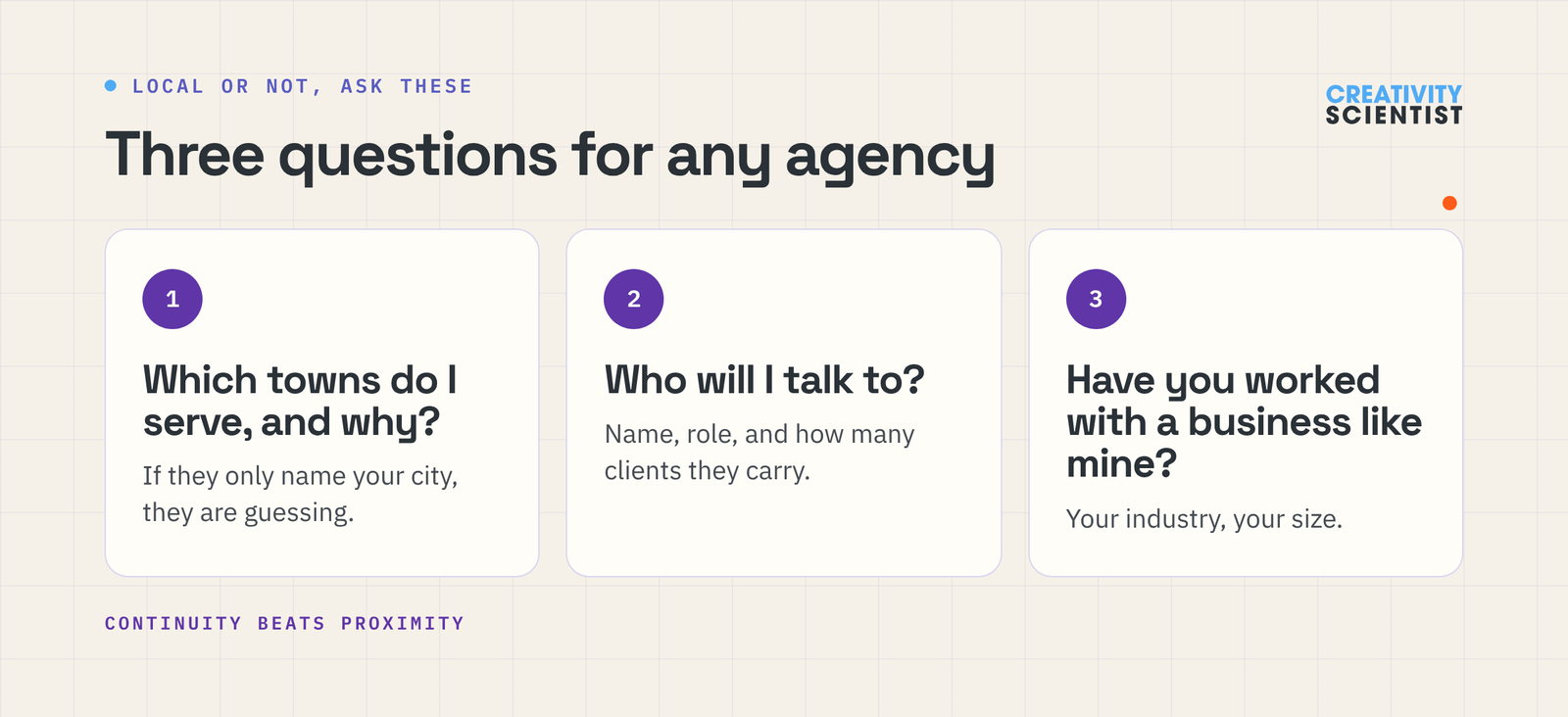
What should you ask a marketing agency, local or not?
The same questions apply either way. I laid out the full set in how to pick a marketing agency, but three matter most here.
Which towns do you think I serve, and why? A firm that knows your market, or has done the homework, can answer this before you tell them. If they say your city and stop, they are guessing.
Who will I actually be talking to? Name and role. Then ask how many other clients that person carries.
Have you worked with a business like mine? In your industry, at your size. Someone who has worked inside a business like yours knows things neither a big national agency nor a local generalist does.
When is a remote marketer the better choice?
When your buyers are spread out, when the work is mostly technical or strategic, or when you care more about talking to the same senior person every time than about meeting in person. It is also the better choice when the best fit for your industry happens to live somewhere else. Nobody nearby may know manufacturing or your trade as well.
Where do I fit?
I work with home service businesses and manufacturers across the US, in person when it counts and remote the rest of the time. I learn each market from the data: town-by-town rank tracking, your call logs, your past jobs and who your best customers actually are. That is the local knowledge that matters, and it doesn’t require living down the street.
I’m not the right fit for everyone, and it is cheaper for both of us to find out early. If you need one channel run at volume and you already know exactly what you want, you want an agency, not a consultant. If you are not sure what is broken, that is the work I do.
The bottom line
When your customers are local, hire someone who learns your actual map, whether they live down the street or not. Don’t pay a premium for “local” on work that is the same everywhere. And weigh continuity above proximity. If you want a quick read on which parts of your marketing actually need local knowledge, book 15 minutes with me.
Frequently asked questions
1Does a marketing agency need to be local?
No, but it needs to learn your local market if your customers are local. Your Google Business Profile, target towns and reviews depend on that knowledge. Technical SEO, CRM, email and strategy are the same work wherever the marketer is.
2What should I ask a local marketing agency before hiring them?
Ask which towns they think you serve and why, who you will actually talk to and how many clients that person carries, and whether they have worked with a business like yours. Their answers show whether they know your market or are guessing.
3Is a local marketing agency more expensive than a remote one?
Not by rule. Price tracks size, overhead and scope more than location. Compare what each one includes and who does the work, not where the office is.
4How do I know if a marketing agency actually understands my local area?
Ask them to name the nearby towns that matter for your business before you tell them. Someone who has done the homework can point to rank tracking, search data or your call history. Someone who only names your city is guessing.
5Can a remote marketing agency handle local SEO?
Yes. Local SEO runs on your Google Business Profile, town-level rank tracking, service-area pages and reviews. All of it can be done remotely if the person studies your data and works with your team on the review habit.
6What is the main advantage of hiring a local marketing agency?
Easier in-person meetings and, sometimes, existing knowledge of your area. The bigger advantage most people want is continuity, the same person every time, and that comes from the size of the firm, not its location.