Updated November 2026
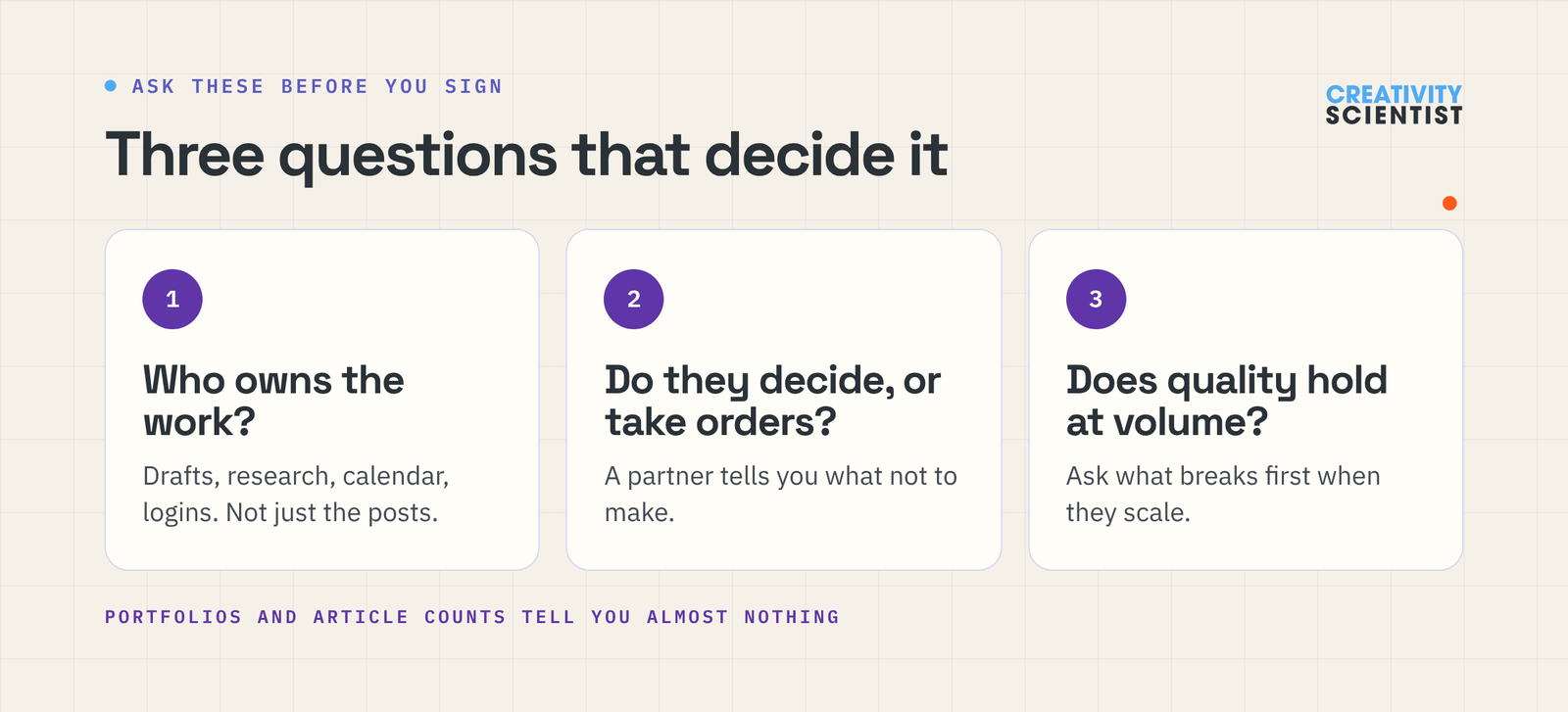
Choose a content partner on three things: who owns the work when you leave, whether they decide what to make or just make what you ask, and whether quality holds when the volume goes up. Portfolios and monthly article counts tell you almost nothing about any of the three.
Most content partnerships don’t fail on quality. They fail on ownership, on judgment, or on what happens in month four when the volume doubles. Here is what to ask, and what a good answer sounds like.
- →Ask who owns the work before you ask to see samples.
- →A portfolio proves they can write. It doesn’t prove they can make you money. Ask for the traffic, not the article.
- →The real question is not “can you produce content” but “can you decide what is worth producing.”
- →Be wary of anyone who quotes a monthly article count before they have looked at your business.
- →Scale is not volume. It is whether quality holds when the volume goes up.
Who owns the content when you leave?
It sounds like a legal detail. It is the most expensive thing to get wrong, and it almost never comes up until the relationship ends.
Ask directly: if we stop working together, what do I keep? The published articles, obviously. But also the drafts, the keyword research, the content calendar, the briefs, the style guide and the logins. Some deals leave you with published pages and nothing underneath them, which means starting over with the next partner. Ask in the first conversation. The answer tells you what kind of relationship this is.
What does a portfolio actually prove?
That they can write. That is table stakes, and it is not what you are buying. What you want to know is whether the work performed. So change the question. Instead of “can I see samples,” ask: pick a client and show me what happened. Traffic before and after. Which pages ranked. How long it took. What did not work.
A partner worth hiring has that data and will show it, misses included. Be a little suspicious of very clean case studies. Real content work has a piece that flopped and a quarter where nothing moved.
Do they decide what to make, or take orders?
This is the real fork, and it decides what you are actually buying.
| Order-taker | Partner | |
|---|---|---|
| Starts with | Your topic list | Your buyers’ questions and your gaps |
| Quotes you | An article count, up front | A plan, after looking at your site |
| Will tell you | Yes to everything | What not to make |
| Measures | Posts delivered | Rankings, citations and leads |
Most businesses buy an order-taker and expect a partner. Then they are frustrated when the content is fine and nothing happens, which is exactly what content marketing looks like when it follows a calendar instead of a buyer. The tell: a monthly article count quoted before anyone has looked at your site. That is an order-taker with a partner’s price.
What should you ask a content partner before you hire them?
“What would you tell me not to make?” A good answer names something you are doing now that is a waste. Someone who can’t say no to anything will happily bill you for everything.
“Who actually writes it?” Name and background. Then: how many clients does that person carry, and will I ever speak to them? A lot of content work is sold by a strategist and delivered by a freelancer you never meet.
“How do you learn my business?” The answer should involve talking to you, your sales team and ideally a customer. If onboarding is a brand questionnaire and a competitor list, the output will sound like everyone else in your industry.
“What breaks first when you take on more work?” An honest answer exists. Usually it is research depth, a writer change, or a review step that gets skipped. Someone who says nothing breaks has not scaled anything.
Where does AI fit in a content partnership?
AI made producing content nearly free, which changed what a content partner is worth. It is no longer the writing. It is judgment about what to write, plus enough context that the output sounds like you instead of everyone. So the useful question is not “do you use AI.” Everyone does. It is “what have you built so the output sounds like my business specifically?”
Trained on your voice, your customers and your actual products, AI is the fastest way to keep quality high at volume. Prompted from a blank page, it produces exactly the generic content that search engines and AI answers now skip.
Should you hire a content agency or do it in-house?
It depends on what you are missing. If you have someone who knows your buyers and can write, but not enough hours, outside help for execution is a good trade. If nobody has decided what is worth making, hiring more writers, inside or outside, just makes more of the wrong thing. Sort the decision first, then pick who does the typing.
What are the warning signs when hiring a content partner?
- An article count in the first proposal, before any look at your site or your buyers.
- Samples, but no before-and-after numbers.
- No clear answer on who owns the drafts, research and logins.
- A strategist who sells it and a writer you will never meet.
- No examples of something they told a client not to do.
Do you need a content plan before hiring someone?
You will get far more from any partner if you arrive with a map instead of a budget. The fastest map is a gap check: list the real questions your buyers ask, then file your existing pages under them. The empty rows are your brief. The free content plan template is built for this. Do that first, and you can ask a partner to fill specific holes instead of inventing a strategy from scratch.
The bottom line
Ask who owns the work, ask what they would tell you not to make, and ask what breaks when volume goes up. Those three questions separate a partner from a vendor faster than any portfolio. And bring your own map. If you want help building it, book 15 minutes with me.
Frequently asked questions
1How do I know if a content partner is right for my business?
Ask three things: who owns the work when you leave, what they would tell you not to make, and what breaks when the volume goes up. A good partner answers all three plainly and can show before-and-after results for a real client, including what didn’t work.
2What is the difference between a content partner and a freelance writer?
A freelance writer usually produces what you ask for. A content partner helps decide what is worth producing, based on your buyers’ questions and the gaps in what you already have, and then makes it. If you already know exactly what you need, a good writer is enough.
3How long does it take to see results from a content partnership?
Expect months, not weeks, for search traffic from new pages, and judge it on pages that answer real buyer questions. If nothing has moved after six months, the issue is usually the plan, not the writing.
4Should I hire a content partner if I already have someone in-house?
Often yes, for capacity or direction. If your in-house person knows your buyers but is short on time, outside help with execution works well. If they lack senior direction, look for a partner who can set the plan and support them, not just add more posts.
5What is the biggest mistake businesses make when hiring a content partner?
Buying volume. A monthly article count turns the relationship into production, and success gets measured by posts delivered instead of results. Pay for judgment and a shorter list of pieces that each answer a real question.
6How do I measure whether a content partnership is working?
Track the questions you set out to answer: are those pages indexed, ranking, showing up in AI answers and producing leads? Posts delivered and word counts don’t tell you anything about results.