
- →SEO earns you a ranked spot in a list of links. AEO earns you the quoted answer at the top of the page. GEO earns you the recommendation inside an AI’s written response.
- →AI Overviews now appear on roughly 48% of Google searches (BrightEdge, early 2026), and ranking #1 no longer guarantees you show up inside them.
- →AI referral traffic is still small, but it converts at about 4.4 times the rate of traditional organic visitors (Semrush). Fewer clicks, better clicks.
- →One foundation feeds all three: direct answers up front, structured data, consistent business details everywhere, and real expertise a machine can verify.
A prospect asked ChatGPT for the best marketing help near Worcester last month. The answer named three companies. If you have been doing SEO for years, here is the uncomfortable part: ranking on Google did not guarantee a spot in that answer.
That used to be a two-way story: SEO versus AEO. There is a third job now, and it happens where no search page exists at all. All three matter. They are not the same work, and they are not competing systems. They are layers of one.
What SEO does
Search engine optimization earns you a position in a list of links. Google crawls your site, weighs your content against everyone else who wants the same query, and ranks you. The person searching does the last step themselves: they scan the results, click, compare, and decide.
The work is familiar. Fast pages, clear service and location pages, content that matches what people search for, reviews, links, a tidy Google Business Profile. And it still matters: Google shipped two core updates in spring 2026 alone, and both pushed the same direction. Demonstrated expertise and real depth on your subject win. Thin content built for keyword volume loses. SEO compounds. It is still the base layer of getting found.
What AEO does
Answer engine optimization earns you a place inside the answer itself. When someone asks a question and Google shows an AI Overview, the engine does the comparing for them and hands back a synthesized answer with a handful of sources. There is no page two. Often there is no click at all: Pew Research found that when an AI summary appears, people click a traditional result about half as often (8% of visits instead of 15%).
Those summaries are no longer an edge case. They show up on roughly 48% of tracked queries, up sharply year over year (BrightEdge). And here is the part that stings: a large share of the sources quoted in AI Overviews do not come from the top 10 organic results. The engine is not ranking you. It is deciding whether to quote you.
What GEO does
Generative engine optimization is the newest job: being the business the AI recommends when nobody sees a search page at all. Someone asks ChatGPT, Claude, Gemini, or Perplexity who to hire, and the tool writes back a short list with reasons. That answer is built from two places: what the model learned in training, and what it retrieves live from the web. Both run on the same raw material: what the internet says about you, consistently, in places these systems trust.
This is measurable work, not magic. The Princeton research team that coined the term GEO found that pages with clear statistics, quotable statements, and cited sources were up to 40% more visible in generative answers. One practical wrinkle worth knowing: AI crawlers like GPTBot and PerplexityBot do not run JavaScript, so if your key content only appears after the browser renders it, those systems may never read it.
We went deeper on the tactics in our guide to generative engine optimization. The short version: GEO is reputation engineering. Mentions, reviews, consistent entity data, and content worth quoting.
Three jobs, side by side
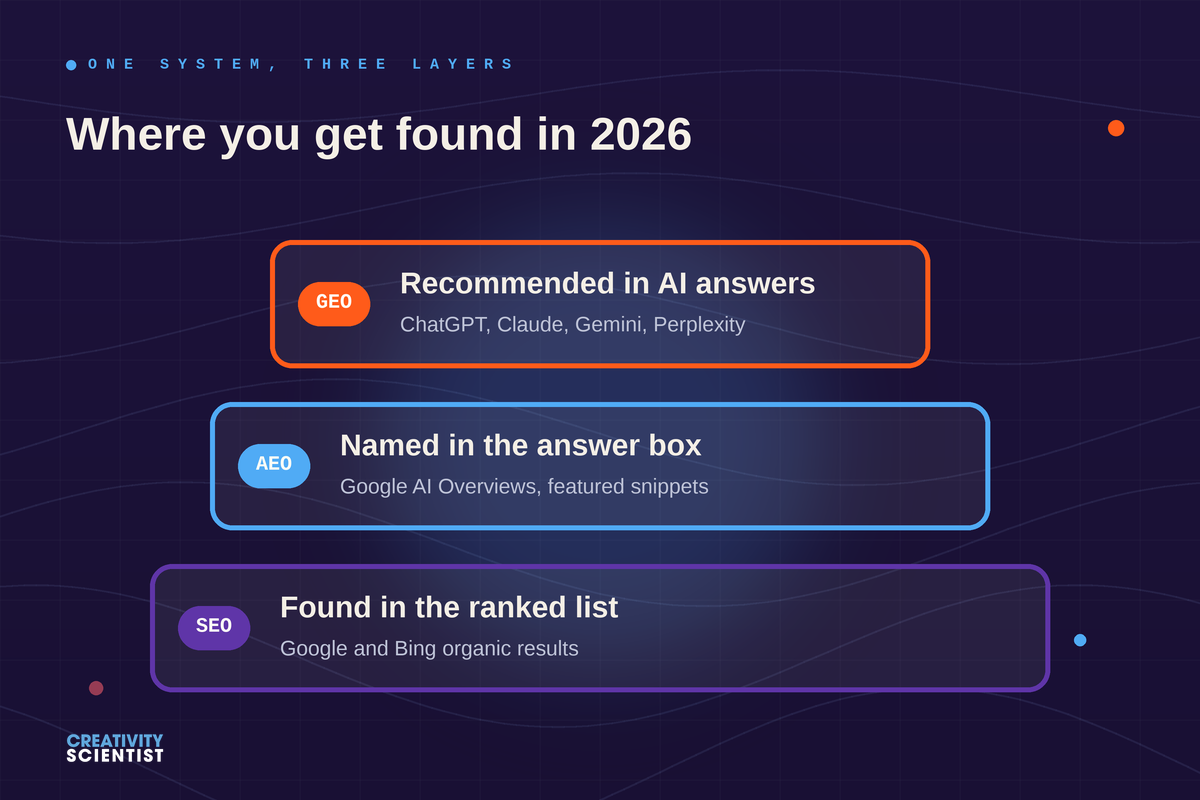
What stays the same
The overlap is bigger than the hype suggests. Real expertise, written clearly, organized so a machine can parse it. Clean headings. Pages that answer one question well instead of ten questions badly. Accurate business data everywhere your name appears. If your SEO was built on substance, you are most of the way to AEO and GEO already.
If it was built on tricks, all three systems will eventually price that in. Google has already started policing attempts to game AI answers the same way it polices spam.
What to do about it
A short list you can act on this quarter:
- Rewrite your key pages so the direct answer sits in the first two sentences, then earn the detail below it.
- Add FAQ, Service, and LocalBusiness schema in JSON-LD so engines can read structure, not just prose.
- Tighten your Google Business Profile and your citations. Same name, same services, same city, everywhere.
- Publish answers to the questions buyers actually ask on calls. One question, one page or one section, with an answer worth quoting.
- Check GA4 for referrals from chatgpt.com, perplexity.ai, and gemini.google.com. Small today. Not staying small.
- Make sure your core content is readable without JavaScript. If the crawler cannot see it, you do not exist to it.
Questions business owners keep asking
1Do I still need SEO if AI answers everything?
Yes. Answer engines and AI tools pull heavily from search indexes, so the site that ranks well is also the site that gets retrieved. SEO is the base layer. AEO and GEO decide what happens to that visibility once a machine starts doing the reading.
2What is the difference between AEO and GEO?
AEO targets the answer boxes on search results, like Google AI Overviews, where being quoted is the win. GEO targets AI chat tools like ChatGPT and Perplexity, where being recommended is the win. In practice they share most of the same work, so treat them as two outputs of one system, not two projects.
3How does my business get recommended by ChatGPT?
There is no pay-to-play and no submission form. These tools recommend businesses that show up consistently across sources they trust: review platforms, directories, press, and your own site saying the same thing everywhere. Consistent entity data, real reviews, and quotable pages are the inputs you control.
4Is AI traffic actually worth anything yet?
It is smaller than organic traffic but noticeably better. Semrush measured visitors arriving from AI tools converting at about 4.4 times the rate of traditional organic visitors, because the AI already did the comparing before they clicked. Fewer visitors, further along in the decision.
SEO gets you found in the list. AEO gets you named in the answer. GEO gets you recommended when there is no list at all. The businesses that treat them as one connected system will take all three.
Not sure where your site stands? Start with a diagnosis. You leave with a roadmap, not homework. Request the free audit.