Updated November 2026
To choose a marketing company in the age of AI, ask five things: do they build systems or rent you deliverables, do you own what they build, is their AI trained on your business, can they get you named in AI answers, and do they report on leads and revenue instead of impressions. Portfolios and price matter less than they used to.
The old way to pick a marketing company was to compare portfolios and prices. A decade ago, a marketing company’s value was its labor: someone to write the blog, run the ads, post to social. AI made that labor cheap. What is scarce now, and what separates a good partner from an expensive one, is judgment and systems. The questions have changed with it.
- →AI made marketing labor cheap. Hire for judgment and systems.
- →Systems keep working after the invoice. Deliverables stop when the contract does.
- →Own your website, ad accounts, CRM and data. Ask what you keep if you leave.
- →AI trained on your business sounds like you. AI prompted from a blank page sounds like everyone.
- →Judge partners on leads and revenue, not impressions and followers.
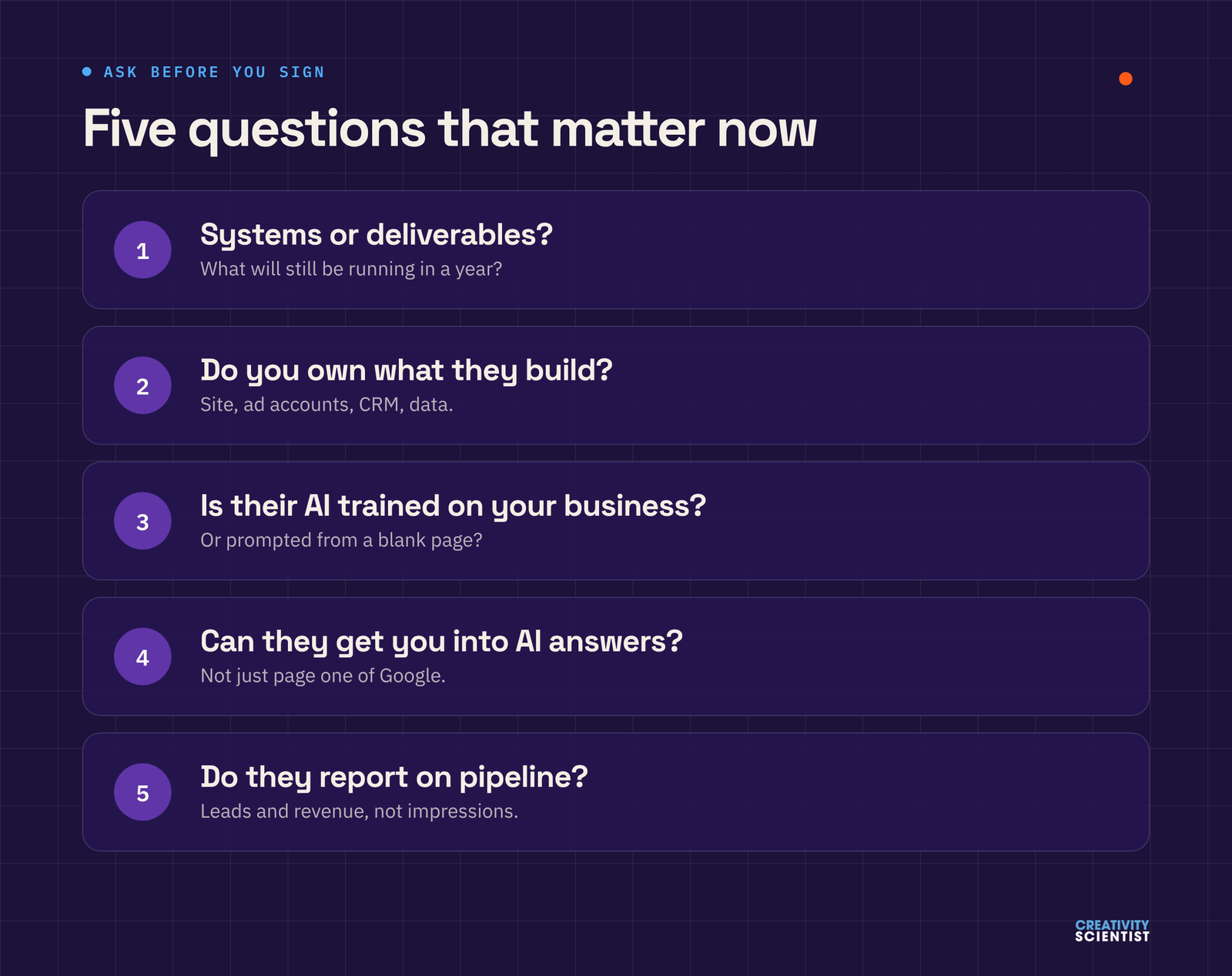
Do they build systems you own, or rent you deliverables?
A deliverable is a blog post, a campaign or a redesign. When the engagement ends, it stops. A system is the CRM, the follow-up automation, the content engine and the reporting that keep working after the invoice. Ask what you will still have running in a year. If the answer is a folder of finished files, you rented labor.
Do you own what they build?
Your website, ad accounts, CRM and data. Some firms build on their own accounts, so leaving means starting over, which is how they keep clients who want to go. A company worth hiring builds on tools you own and hands you the keys. Ask directly: if we part ways, what do I keep?
Do they use AI natively, or resell generic output?
Everyone says they use AI now. The difference is whether it is trained on your business or prompted from a blank page. Generic AI produces content that reads like every competitor’s. The partners getting real results build AI systems around your data, your voice and your customers. In-house at a New England manufacturer, that approach took blog writing from more than 8 hours to under 1 hour per post, and the quality went up.
Can they get you found in AI answers, not just Google?
Your customers increasingly ask ChatGPT, Perplexity and Google’s AI who to hire. Page one of the blue links is no longer the whole game. Ask whether the company understands answer-first content, schema and consistent business details, or whether they are still selling 2019’s SEO. If you want the background, read SEO vs AEO vs GEO.
Do they measure pipeline, or vanity metrics?
Impressions and followers are easy to grow and easy to fake. Leads, booked jobs and revenue are the numbers that pay you. A good partner ties their work to those and tells you when a channel isn’t worth the spend, even their own.
What should you ask before you sign?
| The answer that should worry you | The answer you want | |
|---|---|---|
| What will still be running in a year? | A folder of finished files | A CRM, automation and reporting that keep working |
| If we part ways, what do I keep? | Accounts in the agency’s name | Tools you own, and the keys |
| How do you actually use AI? | Prompted from a blank page | Trained on your data, voice and customers |
| Can you get us into AI answers? | Page one of blue links | Named inside the answer itself |
| What do you report on? | Impressions, followers, activity | Leads, booked jobs and revenue |
Add two more from the older playbook: who will actually do the work, and how many other clients does that person carry? The full list is in how to pick a marketing agency.
What does a good partner do differently?
They look at your whole business before they sell you anything. They fix what actually moves leads, even when it is unglamorous, like follow-up or the CRM. They tell you what you don’t need. And when the work is done, you own a working system instead of a pile of files.
Should you hire an agency, a freelancer or build in-house?
If you know exactly what you need built, an agency or freelancer can execute it. If you have a marketer who needs senior direction, a consultant fits. If nobody is running marketing and you aren’t sure what is broken, start with someone who diagnoses before they sell. The choice is covered in more detail in what a marketing consultant does.
The bottom line
In the age of AI, hire for judgment and systems, not labor you can now get cheaply. The best partners look at your whole business first, fix what actually moves leads, and leave you owning a working system. If you want that kind of read on your own marketing, book 15 minutes with me.
Frequently asked questions
1How do I know if a marketing company actually understands AI?
Ask how their AI knows your business. A good answer describes training it on your buyers, products, proof and voice. A weak answer is a list of tools. Then ask how they get clients named in AI answers like Google AI Overviews and ChatGPT.
2What should I look for in a digital marketing agency in 2026?
Systems you own, AI trained on your business, a plan for showing up in AI answers, reporting on leads and revenue, and a named person doing the work. Portfolios and price are secondary.
3Should I hire an agency, a freelancer, or build in-house?
Hire an agency or freelancer to execute something you already defined, a consultant for direction, and in-house when you need someone daily. If you don’t know what is broken, start with whoever will diagnose before selling.
4How much should I expect to pay for marketing help in 2026?
Most small businesses spend $1,000 to $10,000 a month, depending on scope and who does the work. See what digital marketing costs for the pricing models and what moves the number.
5What is the biggest red flag when choosing a marketing company?
Building on accounts they own instead of yours. If leaving means losing your website, ad history or CRM data, the arrangement is designed to keep you, not to serve you.