
Updated November 2026
To get your business cited in AI search, make it the clearest, most specific answer to the questions your buyers ask. Put a 40 to 60 word answer at the top of each key page, keep your business details identical everywhere online, add schema markup, and earn mentions on the sites AI engines already trust.
That is generative engine optimization (GEO) in one paragraph. Here is why it matters. Ask ChatGPT for the best electrician near you and it does not hand you ten links. It names two or three businesses and moves on. If you are not one of them, that buyer never sees you, no matter where you rank in the blue links.
- →GEO gets your business named inside AI answers from Google AI Overviews, ChatGPT, Perplexity and Gemini. SEO gets you into the list. GEO gets you into the answer.
- →Start with a test: ask AI engines the questions your customers ask and write down who gets named. That gap is your to-do list.
- →Make your name, address, phone, category and description match everywhere. A business that looks like two businesses does not get named.
- →Put the answer first. Studies of AI citations keep finding that most cited text comes from the top third of the page.
- →Small sites have a real shot. The original GEO research found the biggest gains went to pages that were not already ranking at the top.
What is generative engine optimization (GEO)?
Generative engine optimization is the work of getting your business quoted, named or linked inside AI-written answers. Those answers show up in Google AI Overviews and AI Mode, ChatGPT, Perplexity, Gemini and Copilot. The goal is not a top-ten ranking. The goal is to be one of the few sources the AI picks when it writes its answer.
The term comes from a 2024 research paper by a team from Princeton and IIT Delhi, presented at the KDD conference. They tested what changes made a page show up more in AI answers. Adding real statistics, quotations and cited sources lifted visibility by up to 40%. Keyword stuffing did close to nothing.
The part small business owners should notice: the pages that gained the most were the ones that were not already at the top of the results. GEO is one of the few places where a small, specific business can beat a bigger, vaguer one.
How is GEO different from SEO?
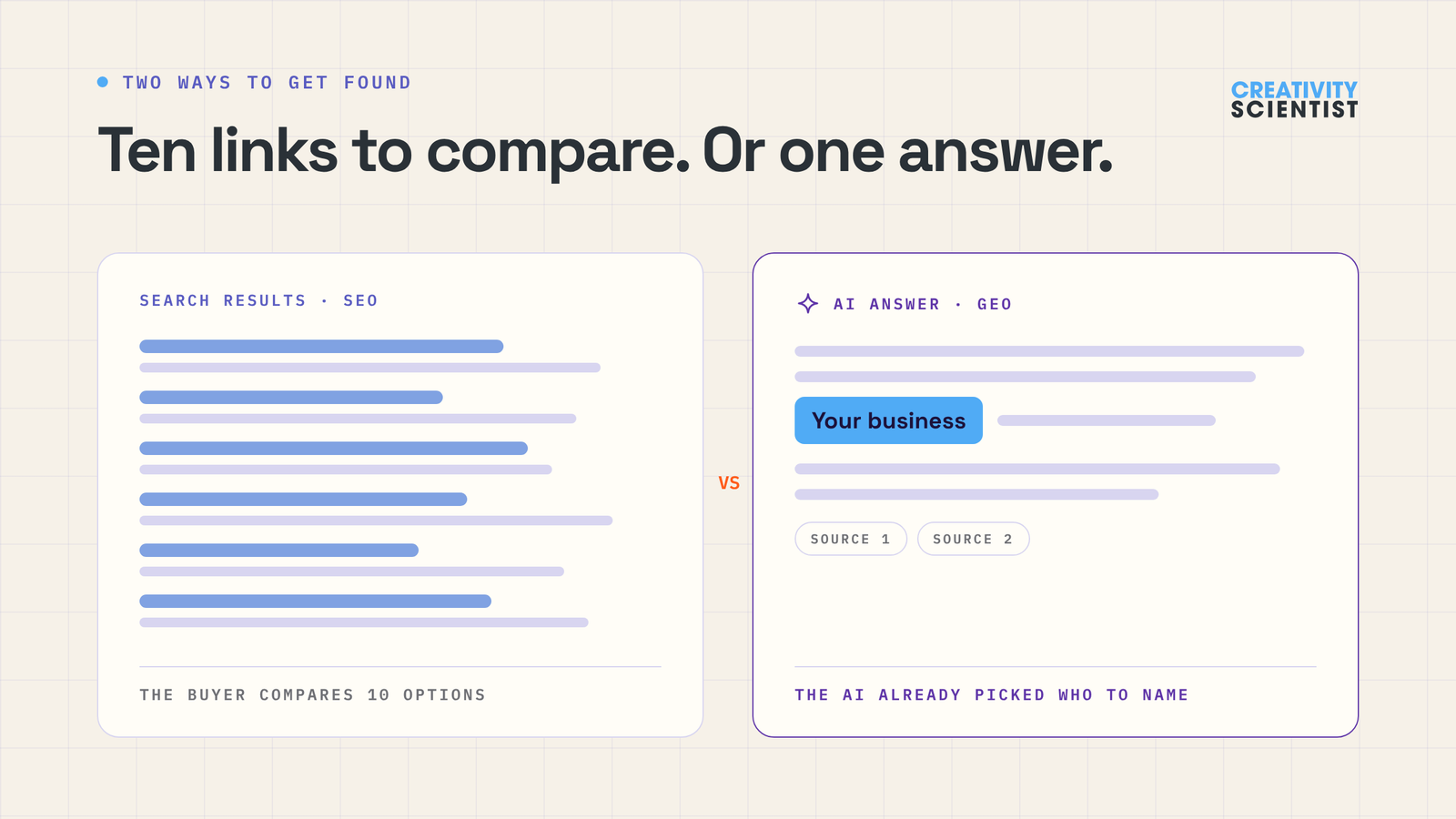
SEO competes for a position in a list of links. GEO competes for a mention inside the answer. With SEO, the buyer clicks, compares and decides. With GEO, the AI has already done the comparing, and the buyer sees one recommendation.
| Traditional SEO | GEO | |
|---|---|---|
| Where you appear | A list of blue links | Named inside the answer |
| What the buyer sees | Ten options to compare | One or two recommendations |
| What it takes | Keywords, links, technical health | Answer-first pages, matching business details, schema, specific claims |
| The outcome | A click, maybe | A recommendation |
They are not rivals. AI engines still pull from pages that search engines can find and trust, so weak SEO caps how far GEO can go. For how the layers stack, see SEO vs AEO vs GEO.
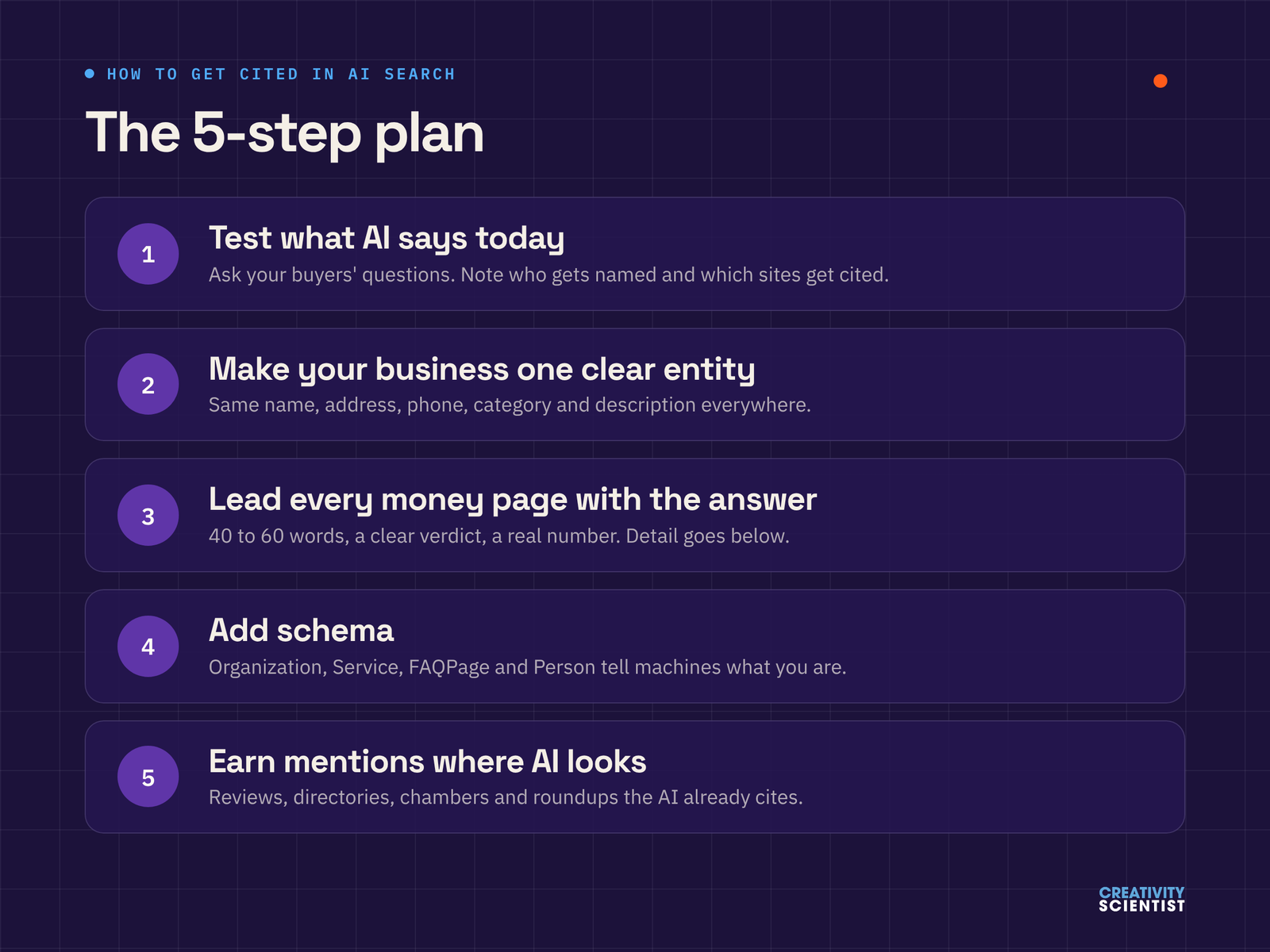
How to get cited in AI search: the 5-step plan
This is the order I work in. Each step makes the next one count for more. None of it needs a big budget. It needs someone to do it carefully and keep it up.
1Test what AI says about you today
Open ChatGPT, Perplexity and Google, then ask the questions your buyers ask. Use their words, not yours. A home service business might ask “best [your service] in [your town]” or “who fixes [the problem you solve] near me.” A manufacturer might ask “who makes [your product] in [your state].”
Write down three things for each question: who got named, which sites the AI cited, and where you showed up (if at all). The businesses named are winning. The sites cited are the places you need to be. Run the same questions again every month, because the answers change.
2Make your business one clear entity everywhere
AI engines piece together who you are from your website, your Google Business Profile, Bing Places, directories, review sites and social profiles. When those disagree, you get blurry.
If your website says “ABC Electric LLC” and your Google profile says “ABC Electrical Services,” that can read as two businesses. Same with your category: “Electrician” in one place and “Electrical Contractor” in another. Pick one version of your name, address, phone, category and one-line description. Then make every listing match it. This is the least exciting step and usually the fastest to fix.
3Lead every money page with the answer
Rewrite the top of each service page, product page and best-performing blog post. Open with a 40 to 60 word answer to the question that page exists for. Name the thing, give the verdict, include the key number. Then explain below it.
“Spray foam insulation costs about $1.50 to $3 per square foot installed” can be quoted. “Spray foam is a popular choice for many homeowners” cannot. Position matters too. Kevin Indig’s study of 18,012 ChatGPT citations found 44% came from the first 30% of the page. If your best answer is in paragraph twelve, the AI may never use it.
Swap vague claims for specific ones while you are in there. “We deliver results” gives an AI nothing to repeat. “Over 100 five-star reviews” does.
4Add schema that tells machines what you are
Schema markup is code on your pages that labels the facts: your business name, location, services, the people behind it and your FAQs. Start with Organization (or LocalBusiness), Service, FAQPage and Person. On WordPress, a plugin like Rank Math handles most of it without touching code.
Schema will not get you cited on its own. It removes guesswork, so the AI does not have to infer what your page is about.
5Earn mentions where AI engines look
Go back to your step 1 notes and look at the sites the AI cited. Those are your targets. For most small businesses they are review sites, your local chamber, the Better Business Bureau, industry directories, trade associations and “best of” roundups in your area or trade.
Get listed with the same details from step 2. Ask happy customers for Google reviews every week, not once a year. And keep your key pages current. Ahrefs analyzed 17 million AI citations and found AI assistants cite content that is about 26% fresher than what ranks in regular Google results. Update the page when the facts change, not just the date.
Which AI engines should a small business focus on?
Start with Google, because most of your buyers still search there and AI Overviews now sit on top of a large share of results. Independent trackers disagree on how large. Similarweb measured AI Overviews on 43% of US searches in May 2026, and other studies of commercial searches put it much higher.
Then ChatGPT and Perplexity, which engineers, researchers and younger buyers use heavily, and Copilot, which runs on Bing. Claim your Bing Places listing and set up Bing Webmaster Tools. It takes twenty minutes and most of your competitors have not done it.
Do not chase every new AI tool. The same five steps work across all of them.
What this looks like in real numbers
These are results from work I did myself, inside the businesses, not case studies I borrowed.
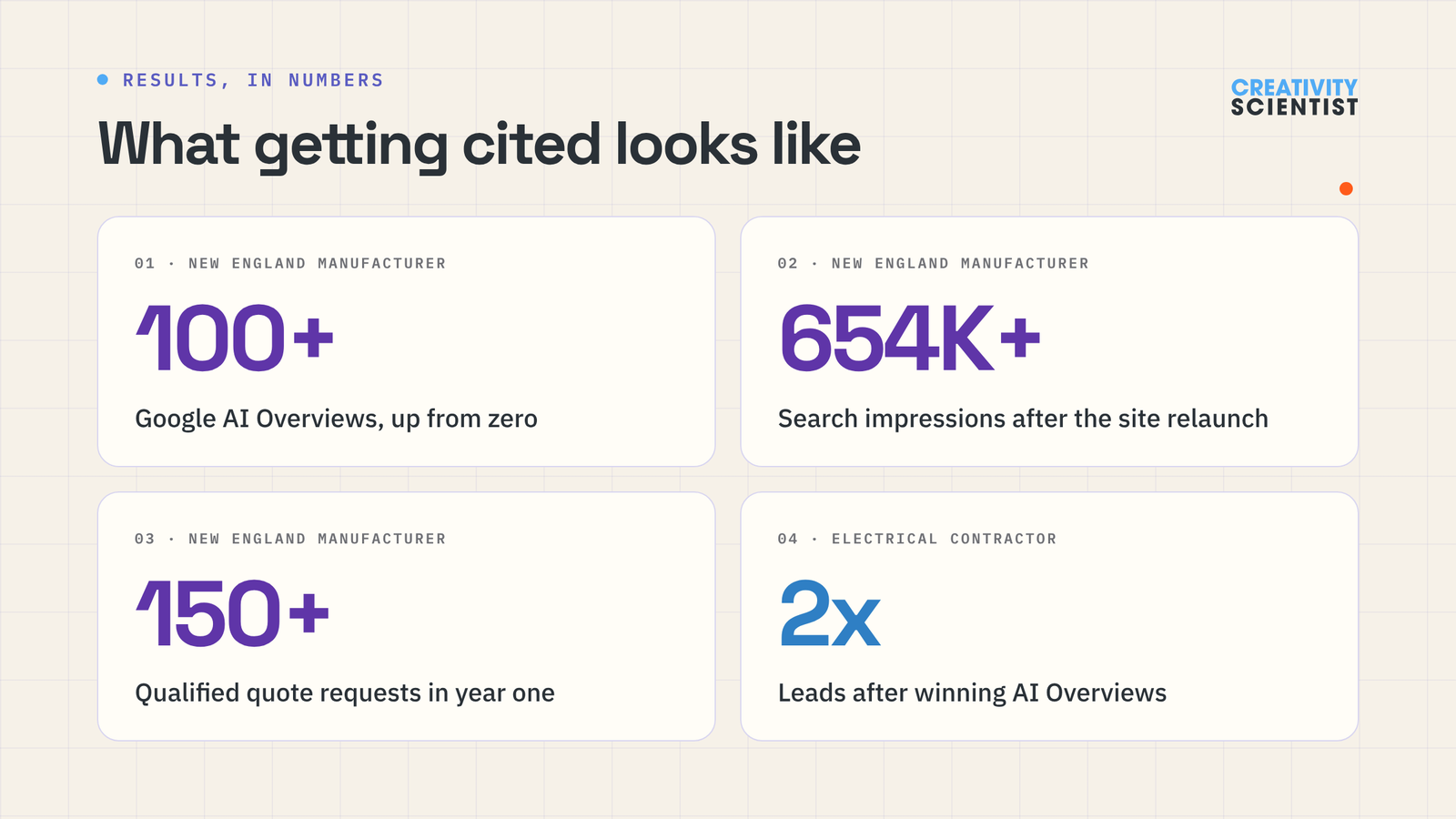
A New England manufacturer where I ran marketing went from zero to more than 100 Google AI Overviews after we rebuilt the site around answer-first pages, matching business details and structured data. The relaunch brought in 654,000+ search impressions and 150+ qualified quote requests in year one. Blog writing time dropped from more than 8 hours to under 1 hour per post with an AI system I built on the company’s own knowledge.
An electrical contractor I work with doubled its leads after it started showing up in Google’s AI Overviews for the questions its customers ask. The same clean, consistent information helped its Google Business Profile, which now has 100+ five-star reviews.
How long does GEO take to work?
I can’t promise a date, and you should be wary of anyone who does. AI engines decide what to cite, and they change how they decide. What I can tell you is the order things tend to move in.
Fixing mismatched business details is usually the quickest win, because it clears up confusion the engines already have about you. Rewriting pages to lead with the answer works once those pages get crawled again. Mentions on outside sites take the longest, because you are waiting on other people. Regular SEO movement often takes three to six months. GEO can move faster on some questions, but only if the basics underneath are in place.
Does GEO replace SEO?
No. GEO sits on top of SEO. You still need a healthy site, pages that answer real questions, links from other sites and the local basics. A business with strong SEO and no GEO ranks well and gets left out of AI answers. A business with GEO and weak SEO gets named now and then but misses the steady traffic. Do both. Most of the work overlaps anyway.
If you want help deciding what to build yourself and what to hand off, read who should build your AI marketing system.
Frequently asked questions
1How do I get my business mentioned in ChatGPT?
Make your business easy to find and easy to quote. Keep your name and details identical across your website, Google and Bing listings and directories. Lead your key pages with short, specific answers. Earn mentions on the review sites and directories ChatGPT already cites for your type of business, then check monthly by asking it your customers’ questions.
2How do I get into Google AI Overviews?
Answer the exact question in the first lines of the page, in 40 to 60 words, with a specific fact or number. Make sure the page is indexed and already earns some trust in regular search, add FAQPage and Organization schema, and keep your Google Business Profile complete and consistent with your site.
3What is the difference between SEO and GEO?
SEO gets your page into the list of links a search engine shows. GEO gets your business named and quoted inside the AI-written answer itself. They overlap heavily, and strong SEO makes GEO easier, but GEO is judged by whether you are the cited source, not by your ranking.
4How do I know if AI engines mention my business today?
Ask them. Put your customers’ real questions into ChatGPT, Perplexity and Google, and note who gets named and which sites get cited. If you are missing, that list of named businesses and cited sites is your to-do list.
5Do I need an agency to do GEO?
No. An owner can run the AI test and fix mismatched listings in an afternoon. The harder parts are rewriting pages, adding schema and keeping it current. That takes steady, careful work more than a big team, which is why one person who does the work themselves is often a better fit than an agency.
The next step
Run the test in step 1 this week. If you do not like what you see, or you would rather have someone fix it for you, book 15 minutes with me. I’ll ask a few simple questions about your business, and you will leave knowing what to fix first.
Keep reading: SEO vs AEO vs GEO · AI marketing for small businesses in 2026 · Who should build your AI marketing system · How to choose a marketing company in the age of AI